Saturday, January 29, 2011

Smoke and Mirrors in Corvallis

Corvallis has a long tradition of protecting the streams, creeks, watersheds, and rivers in and adjacent to the city.  Dunawi Creek Tour - City of Corvallis is an example of what the city does for protection. However, the city follows this tradition only when it is convenient. The newly approved Creekside Center development, at the northwest corner of Philomath Blvd. and 53 St., is a project that as approved will destroy an Ash Wetland and severely impair Dunawi Creek.

Both the city and the developer have recognized this wetland for what it is. See photos of warning signs now on the site. The smoke and mirrors comes into play with the unique remedy the city gave to the developer for mitigating the destruction of the wetland on the south side of Dunawi Creek. The city requested the developer to build a 12 foot wide asphalt hiking trail through the wetland on the north side of Dunawi Creek. Hmm!! interesting reasoning here on the part of the city planners.

Liz and Bob Frenkel, both local seasoned riparian and political experts, have brought this misguided reasoning to the attention of both the city's planning commission and the city council. The city has completely ignored this information and approved the development which will include a Walgreen Drug store, several shops, and apartments. Only one city council member objected to this development. Surprisingly one of the Pacific Green Party members of the council approved the project. The other Pacific Green Party member recused himself from voting.
I wonder if Walgreen Drug knows that it is participating in the destruction of, in the city's own words,  "one of Corvallis' wild and wonderful urban streams."

Friday, January 28, 2011

Swans, Poets, and Friends

Mary Oliver’s poetry snaps my body in all directions trying to find her images in the air. I looked for her images while walking with friends on the wooden boardwalk at Cabal Marsh on the Finley Wildlife Refuge. Finley is about 15 miles south of Corvallis, Oregon on Muddy Creek. In the winter every year thousands of migratory ducks, geese, and swans hang out here to graze on the lush winter grasses in the refuge and on the near by farmers' fields. The Tundra Swans with their glistening black bills and sparkling white feathers float regally lording it over the much smaller Dusky and Cackling Geese.
Every once in a while on this wintry Sunday afternoon a playful Bald Eagle would swoop down to the slough spooking hundreds of geese into the air.

This is a small piece of Mary Oliver’s “The Swan.”

A white cross Streaming across the sky, its feet
Like black leaves, its wings Like the stretching light of the river?
And did you feel it, in your heart, how it pertained to everything?
And have you too finally figured out what beauty is for?
And have you changed your life?

And these are photos of my friend and I who enjoyed the bald eagles, tundra swans, and “The Swan.”


Wednesday, January 26, 2011

Beaver Creek State Park Oregon

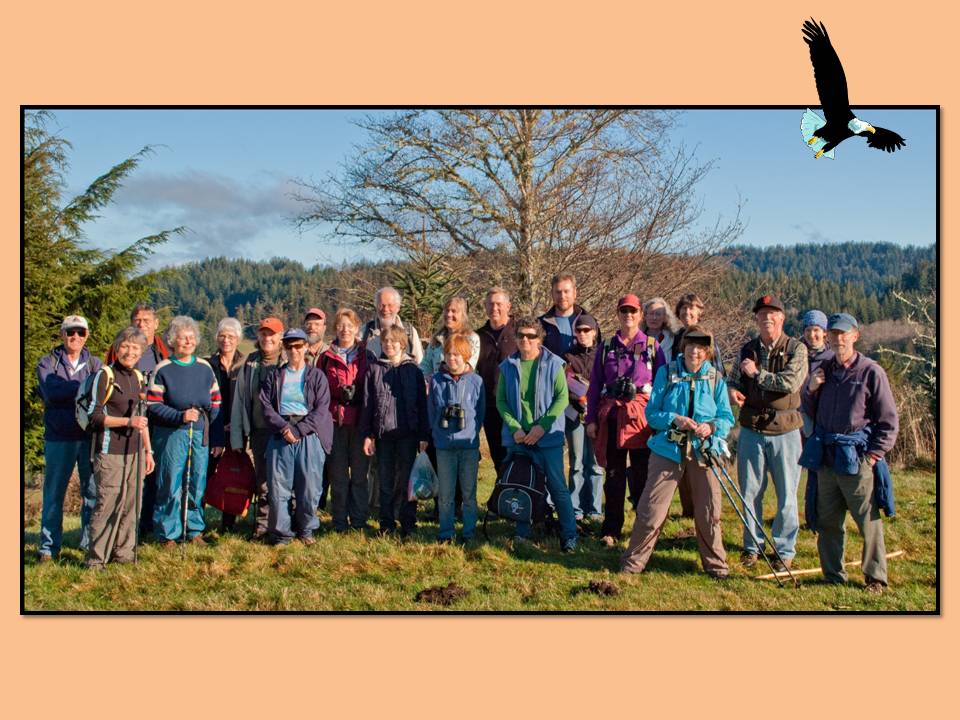
Beaver Creek, Oregon’s newest state park is a big hit with the Marys Peak Group of the Oregon Sierra Club. 26 of the group hiked this new park in the bright sun Saturday, January 22. The view from Snaggy Top is all the way to Ona Beach and the Pacific. We ate lunch in this delightful meadow while our photographer, Ricardo Small, was busy documenting the scene. Brian Fowler, the park ranger, has organized a weekly bird count every Saturday for the whole of 2011. If you are lucky, like we were, you might get some fresh baked cookies from the park hosts.
The park is on North Beaver Creek Road just over a mile inland from Ona State Beach. The turn to Beaver Creek State Park is about 8.5 miles south of Newport, Oregon off of Highway 101.
Here is Ricardo's group photo.


Marys Peak in January


Who would believe the East Ridge Trail to the top of Marys Peak is dry and warm this time of year. Here it is the end of January and the snow is gone. The Rattlesnake Orchids and White-lined Wintergreen are sprouting out fresh leaves. The Evergreen Huckleberries on top of the stumps look like they are ready to blossom.
Once you are above the valley fog on the East Ridge Trail you can see all the way to the 3 Sisters and Mount Jefferson. 
When the weather is like this in winter I am wondering if it is a sign of a warmer planet.  No way for me to know, but the Jazz loved the trail, and she is not covered with mud like she is from a run at the river.

Sunday, December 31, 2000

Mukuni Village Zambia

There is a quiet cool hill top 5 kilometers from the Zambezi River and the Mosi-oa-Tunya Falls. This is where 7000 Tonga people live in the village of Mukuni.


Photo by Naiomi

Two of us got a ride from Livingstone to Mukuni. We could see the spray oand feel the humidity of the Falls until we left the paved road to Zimbabwe and drove up into the hills on a red dirt road.


Photo by Naiomi


The air got cooler and cooler as we climbed through the corn, soy bean, and millet fields of the Tonga People.


Photo by Naiomi


The air cooled with a very nice breeze, and there was a special calm feel to the air as we left the vehicle in the center of the village. Here we met Ma Felistus Mwaanga who was to guide us through the village.
These were very poor people who had only had their own well on the hill top since 2000. That was when electric power had been brought up to the village to power their two wells. Before this women had to walk the 5 kilometers to the Zambesi to cary eir water back up hill in 5 gallon buckets.
Ma Mwaanga introduced us to a few families and walked us through one family compound where the father showed us his drying ground nuts, Amarula berries, and chickens. There was one small bedroom hut for the mother and father, institute daughters, one for the sons, and one for cooking. They had a large enclosue for washing and laundry, but all toilet facilities were out in the bush outside the village.


Photo by Naiomi


Just outside each family compound was the family garden of okra, squash, and tomatoes.


The Tonga Chief lives in Mukuni village, but he rules over 110 villages. He is chief for life, but he cannot resign. There is a special hut in his compound. This hut is for the chief to die in if he starts making many bad decisions.
There have 19 chiefs for this group of tonga people. There ips a special stone, "Living Stone", that the new chief is given to swallow during the coronation ceremony. This same stone has resided in each of the 19 preceding chiefs.

Herreros

The people of this northern desert were once thought to be a military threat to the German Empire. So the German military attache led a expedition of extermination against these people killing 90%.


Today I bought a wonderful fetish for my journey from this woman and last evening I danced with several of them at our camp for the evening. The fetish worked just fine because a thunderstorm brought a deluge just after I settled into my flea for the evening. The storm rocked me to sleep!!